February 26th, 2009 · Comments Off on Owning IS Better Than Renting
One popular housing theory is that — before a bona fide housing recovery can begin — the cost of owning a home versus renting one must return to historical levels.
If that belief is a truth, a national return to rising home prices may be in store for 2009.
Falling home prices coupled with falling mortgage rates, too, have dropped the relative, after-tax cost of owning a home to 125% of the cost of renting a home.
This is the exact 18-year historical average and not since 2001 has the gap been this small.
As reported by the Wall Street Journal, though, the study has some flaws. For example, the data doesn’t account for ongoing home maintenance costs, nor does it consider real estate tax bills and insurance policies.
But, combining a relatively low cost of ownership with the government’s $8,000 tax credit for first-time home buyers is likely to convert long-time renters into never-before homeowners.
This, too, is thought to be a key element of the housing recovery.
In Philadelphia, typically the cost of owning has been very close to the cost of owning, and that fact, combined with the tax benefits of home ownership, and the financial stability of our housing market, has always tilted the scales in favor of owning a home. While our market has demonstrated remarkable price stability in light if the current economic issues, in many other markets (but not all), home prices are expected to edge lower through 2009. Provided mortgage rates stay low, the cost gap between owning and renting will shrink even more.
(Image courtesy: Wall Street Journal)
Tags: Economy · Local · New Jersey · Pennsylvania · Real Estate
February 25th, 2009 · Comments Off on Indirect Benefits of the Stimulus Package
The American Recovery and Reinvestment Act of 2009 was signed into law Tuesday February 17th in Denver, Colorado. Also on Tuesday, stock markets fell near their November 2008 lows.
The two moves are related.
With each new stimulus; with each potential jumpstart of the economy, Wall Street questions whether the federal push will be enough to make an impact.
Traders ended undecided on that issue yesterday, but resolute in something else — that whatever change stimulus bill brings, it’s not going to come fast enough to help.
The sell-off in equities was a boon to home buyers. For the first time since early-December, mortgage markets gave a sustained rally, extending gains from the 8:30 AM market open through the 4:00 PM market close. Conforming mortgage rates were down on the day.
Longer-term, though, it’s not likely that pattern will last. Not only will the stock market eventually find balance, but, more importantly, there was verbiage in the stimulus bill that increased the nation’s debt ceiling by 53.4 percent. Debt, of course, is often financed with the printing more money and that leads to inflation.
Tags: Economy · Mortgage Lending
February 24th, 2009 · Comments Off on Philadelphia Asbestos Prevention & Removal
Jesse Herman, the Awareness Coordinator at the Mesothelioma Cancer Center (www.asbestos.com) reached out to me recently to provide some important consumer information – I hope you find it useful!
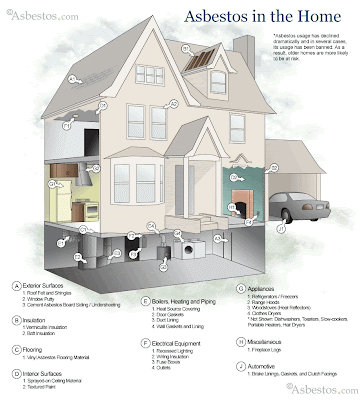
Regarded as the “rust belt” state, Pennsylvania has a history of asbestos use in mining and manufacturing. Home to the Philadelphia Naval Shipyard, this was a breeding ground for asbestos exposure incidents. Philadelphia’s shipyard built more than 50 new vessels during World War II and repaired hundreds of other ships. Due to its qualities as fire resistant, durable and flexible, asbestos was the ideal material for homes, buildings, ships and other industrial applications. If you are a potential homebuyer in Philadelphia or are seeking to remodel an older home, there are many things worth considering.
Although asbestos exposure does not always lead to a related disease, when buying or selling a home, consumers should relay questions to their agents regarding building materials that contain asbestos. Due to the potential health effects of exposure to asbestos fibers, it is recommended that homebuyers determine if asbestos containing building materials are present.
The consistent inhalation of asbestos fibers can cause a severe lung-ailment known as malignant mesothelioma. This rare form of asbestos lung cancer accounts for three percent of all cancer diagnoses in the U.S. alone. With an extremely high amount of asbestos incidents through the last century, many mesothelioma lawyer firms began fighting for victims rights. Asbestos manufacturers were clearly aware of the health damaging qualities involved with their product, but chose to cover it up, leaving millions of workers, military personnel and civilians exposed to the material.
A professional home inspection is extremely important in a variety of scenarios. To protect your investment, professional consultants can provide an evaluation of the home. If the asbestos appearing is deemed harmful, the Environmental Protection Agency recommends for asbestos removal in homes, workplaces and public facilities to be performed by licensed abatement contractors, who perform under the strict regulations in regards to the handling of asbestos.
Eco-friendly options must be considered when the removal is complete. The use of recycled building materials as forms of insulation completely replaces the need for asbestos. These alternatives include cotton fiber, cellulose and lcynene. Studies show that these materials can reduce energy costs in the home by up to 35 percent each year. Turning your home asbestos-free is essential for living in a safe environment for you and your family.
![Reblog this post [with Zemanta]](http://img.zemanta.com/reblog_e.png?x-id=be643ba9-7805-43ac-b61b-7df168754c0f)
Tags: Consumer Interest · Local · New Jersey · Pennsylvania · Real Estate
February 23rd, 2009 · Comments Off on Higher Home Loan Limits Return!
Everything old is new again.
Conforming mortgages are limited by loan size, based on “typical” housing costs around the country. The current conforming limit on a single-unit property is $417,000.
In 2008, as part of the Economic Stimulus Act of 2008, Congress authorized conforming loan limits increases in “high-cost” areas around the country. In Los Angeles County, for example, a mortgage could be as large as $729,750 and still be considered “conforming”.
Those temporary increases rolled back effective January 1, 2009, to a maximum of $625,500.
However, as part of the American Recovery and Reinvestment Act of 2009 signed into law this week, conforming loan limits in high-cost areas have been returned to their elevated levels of 2008.
You can see the text on the bottom of page 111 of 407.
Changes to conforming loan limits impact everyone with a stake in real estate, even if their neighborhoods are not considered “high-cost”. This is because conforming mortgages offer the widest selection of home loan products, and often at the lowest rates. The widespread availability of conforming mortgages helps to support home sales nationwide as well as providing ample refinancing options for people that need it.
Lenders have yet to pick up the change, but are expected to shortly. Once they do, more homeowners will be eligible for cheap home financing.
To lookup your neighborhood’s conforming loan limits, visit the HUD Web site. Or, if you have specific questions related to your home or an upcoming purchase, contact me directly anytime.
Tags: Economy · Mortgage Lending
February 19th, 2009 · Comments Off on Stimulus Packages Good for Green And 1st Time Buyers!
 Image by djbones via Flickr
 With Congress reaching agreement on a $789 billion stimulus package for Americans and the President expected to sign it into law, the clock may be ticking for this year’s home buyers and homeowners.
The package contains two benefits related to housing.
The first provision is fairly well-known. It gives first-time home buyers an $8,000 tax credit provided they purchase a home between January 1, 2009 and August 31, 2009.
This is a true tax credit.
To reduce misuse and abuse, however, the $8,000 credit is contingent on home buyers holding property for at least 3 years. If the home is sold in fewer than 3 years, the tax credit must be repaid to the government. It’s also worth noting that the date range applies closings and not sales agreements.
Closings must occur within these 8 months to be eligible.
A second noteworthy feature in the package is that the stimulus package gives existing homeowners incentive to “green” their homes. With available tax credits for energy-efficient windows and doors, furnaces and insulation, homeowners can claim larger tax deductions based on home improvement, up to $1,500.
But, just because the government provides housing-related tax benefits doesn’t mean you should just act on them blindly. Tax liability is a highly individual item and you may be ineligible for any number of reasons. Be sure to discuss your plans with a qualified accountant before committing to a plan.
Tags: Economy · Mortgage Lending · Real Estate
February 18th, 2009 · Comments Off on Good News for Real Estate Investors!
 Image by thinkpanama via Flickr
Last Friday, Fannie Mae rolled-back one of its least popular mortgage guidelines updates of the last 12 months.
Effective March 1, 2009, real estate investors can once again own and finance up to 10 individual properties. The restriction reversal does come with new minimum requirements, however.
Homeowners buying a 5th, 6th, 7th, 8th, 9th or 10th home must meet the following standards, as set forth by Fannie Mae:
- 720 credit score
- 25% downpayment for a 1-unit (30% for a 2-4 unit)
- No mortgage delinquencies in the last 12 months
- 6 months of reserves for each investment property
In other words, Fannie Mae is re-opening the lending spigot for real estate investors with good credit, a sizeable downpayment and ample reserves.
According to Fannie Mae, the change rationale is that experienced investors can “play a key role in the housing recovery”. Until now, foreclosure auctions have gone at less than full speed because investors unable to pay cash have been halted by the existing 4-property Fannie Mae limit.
Going forward, expect a more expedient foreclosure liquidation nationwide which should, in turn, provide further support for the housing market.
And lastly, not to be forgotten, homeowners with more than 4 properties can finally participate in the ongoing conforming mortgage Refi Boom. Until now, they’ve been stymied by the 4-property restriction, too.
Tags: Economy · Mortgage Lending · Real Estate
February 17th, 2009 · Comments Off on Housing Sales Increase though Consumer Confidence Doesn’t!
Consumer Confidence fell this month for the first time in three months, reflecting Americans’ concern for the economy, housing, and the financial system.
The reading isn’t much of a surprise given our collective exposure to a near-constant stream of negative news. Before long, the reports become a self-fulfilling prophecy.
Despite falling confidence, however, the housing industry appears to be reviving. Sales of existing homes are on the rise and an increasing number of homes are under contract to sell. And, if these statistics seem out of place, consider the external forces that are accompanying this “down” economy:
- In some markets, home values have plummeted to early-2000 levels
- Government intervention has brought mortgage rates to near-5 percent
- Congress is pledging key support to housing and mortgage markets
These points can’t be captured in confidence surveys which, by comparison, ignore facts and focus on Big Picture behavioral questions like “Do you think you’ll be better off a year from now?” and “What’s your attitude toward buying major household items?”. It’s useful information for economists, but not so much for home buyers.
Anecdotally, a lot of the country’s housing markets have already started their recovery. Couple that with the natural momentum of Spring Buying and the stimulus package’s proposed first-time home buyer tax credit and you can clearly see the disconnect.
Just because confidence is down doesn’t mean that home prices will be, too.
Tags: Real Estate
February 10th, 2009 · 1 Comment
Comparing July’s conforming mortgage rates to today’s average rates, there’s a 1.5 percent difference in favor of homeowners.
Rate drops like that make big differences in a household budget. Look at these before-and-after payments, based on rates from the chart:
$150,000 mortgage ($144 savings/month)
- July 2008: $958 monthly
- February 2009: $814 monthly
$250,000 mortgage ($240 savings/month)
- July 2008: $1,597 monthly
- February 2009: $1,357 monthly
$350,000 mortgage ($335 savings/month)
- July 2008: $2,235 monthly
- February 2009: $1,900 monthly
Of course, the other side of the story is that while mortgage rates fell through late-2008, the mandatory lender fees that accompanied them rose. That lessened some of the benefits of getting lower rates, but certainly not all of them.
According to recent housing data, buyers are back writing contracts and listed homes are selling quickly. Considering how mortgage rates have led monthly payments lower, maybe it shouldn’t be much of a surprise.
Tags: Real Estate
February 9th, 2009 · Comments Off on Good News About Home Sales!

A real estate trade group reported Tuesday that Pending Home Sales ticked higher in December 2008. A “pending home sale” is a home under contract to sell, but not yet closed.
The group positions Pending Home Sales report as a predictor of future activity, suggesting that home sales will spike 60 days hence.
This is good news for the economy.
However, despite the Pending Home Sales report’s correlation to the actual number of homes sold in the future, that connection may not be the report’s best use. This is because of what Pending Homes Sales doesn’t measure.
Specifically not included in Pending Homes Sales are:
- Sales of new construction homes
- Sales of For Sale By Owner properties
- 80 percent of non-surveyed MLS transactions
And, lastly, it should be noted that Pending Home Sales tracks contracts — not closings — and until a home is sold and closed, nothing has really happened in the economy. That’s especially relevant in a market like this in which finding financing isn’t always so easy.
Pending Home Sales still has its place, though, because it’s a terrific look at the current buy-side demand for homes. Clearly, low mortgage rates and falling home prices are making an impact and this is why the December’s Pending Home Sales report is so important. It’s the third housing report this month that shows the demand for homes rising while the supply of homes falls.
The other two reports:
- The number of “used” homes sold monthly is rising
- The number of new homes being built are falling
This is good news for home sellers and for the economy. As the amount of inventory decreases, the existing inventory has greater value to the consumer who is looking to buy, benefitting the people who have already acted and secured their properties. If housing is expected to lead the U.S. out of recession, the seeds for that recovery may have already been planted.
(Image courtesy: The Wall Street Journal)
Tags: Economy · Real Estate
February 4th, 2009 · Comments Off on Selling Your Home for More Money in Less Time!
Super Bowl Weekend traditionally marks the start of the Spring Buying Season in real estate. Anecdotally, real estate agents will tell you that buyer activity tends to tick higher at this time of the year.
Meanwhile, with mortgage rates still trolling near all-time lows and Congress debating a first-time homebuyer tax credit, 2009 may bring out even more buyers than we’ve seen in the past.
Just having your home on the market may not be enough to attract an offer, though — the home has to have appeal. That brings us to home staging — the process by which a homeowner re-organizes and re-presents his home to appeal to as many potential buyers as possible.
Home staging is part-science, part-art, and part-psychology. Homebuyers tend to judge homes within the first 8 seconds of seeing them so making a quality first impression can mean the difference between getting multiple bids, and just getting a lot of foot traffic.
The 4-minute video gives some quick-and-easy tips, including:
- Create more light in the home
- Clean up the closets and thin them out
- Remove the clutter from every room in the house
Even though home inventories are falling, supplies are still higher than in previous years. Home sellers wanting to stand out in a crowd may want to consider staging their homes to help them sell more quickly.
Staged homes sell for as much as 17% more money and as much as 40% faster than non-staged ones.
Tags: Real Estate

 Image by drocksays via Flickr
![Reblog this post [with Zemanta]](http://img.zemanta.com/reblog_e.png?x-id=eb764ee9-1a7b-4bd3-8ac8-0146c545a4c8)

![Reblog this post [with Zemanta]](http://img.zemanta.com/reblog_e.png?x-id=2923fb04-1bad-4e30-92c3-864228574441)

![Reblog this post [with Zemanta]](http://img.zemanta.com/reblog_e.png?x-id=97a0c77a-fea6-441f-99d2-84ac188d9540)
![Reblog this post [with Zemanta]](http://img.zemanta.com/reblog_e.png?x-id=fb519c38-8ee6-4688-88a8-bcdd2dd5590c)
![Reblog this post [with Zemanta]](http://img.zemanta.com/reblog_e.png?x-id=93900e6d-7016-4630-8800-38de5c91af01)

![Reblog this post [with Zemanta]](http://img.zemanta.com/reblog_e.png?x-id=109c2b86-fae9-4c92-af49-a45e0d2e2281)

![Reblog this post [with Zemanta]](http://img.zemanta.com/reblog_e.png?x-id=766d103a-794e-4340-b5ba-2ce8d65ee957)
![Reblog this post [with Zemanta]](http://img.zemanta.com/reblog_e.png?x-id=d1bfe27f-0aec-4e9f-80e7-e7e9c66cb6d4)
![Reblog this post [with Zemanta]](http://img.zemanta.com/reblog_e.png?x-id=2c96ab53-2aa8-4ce3-8028-b418aa928f25)
